The Standard

The Official Blog of Health Level Seven® International

visit HL7.org 

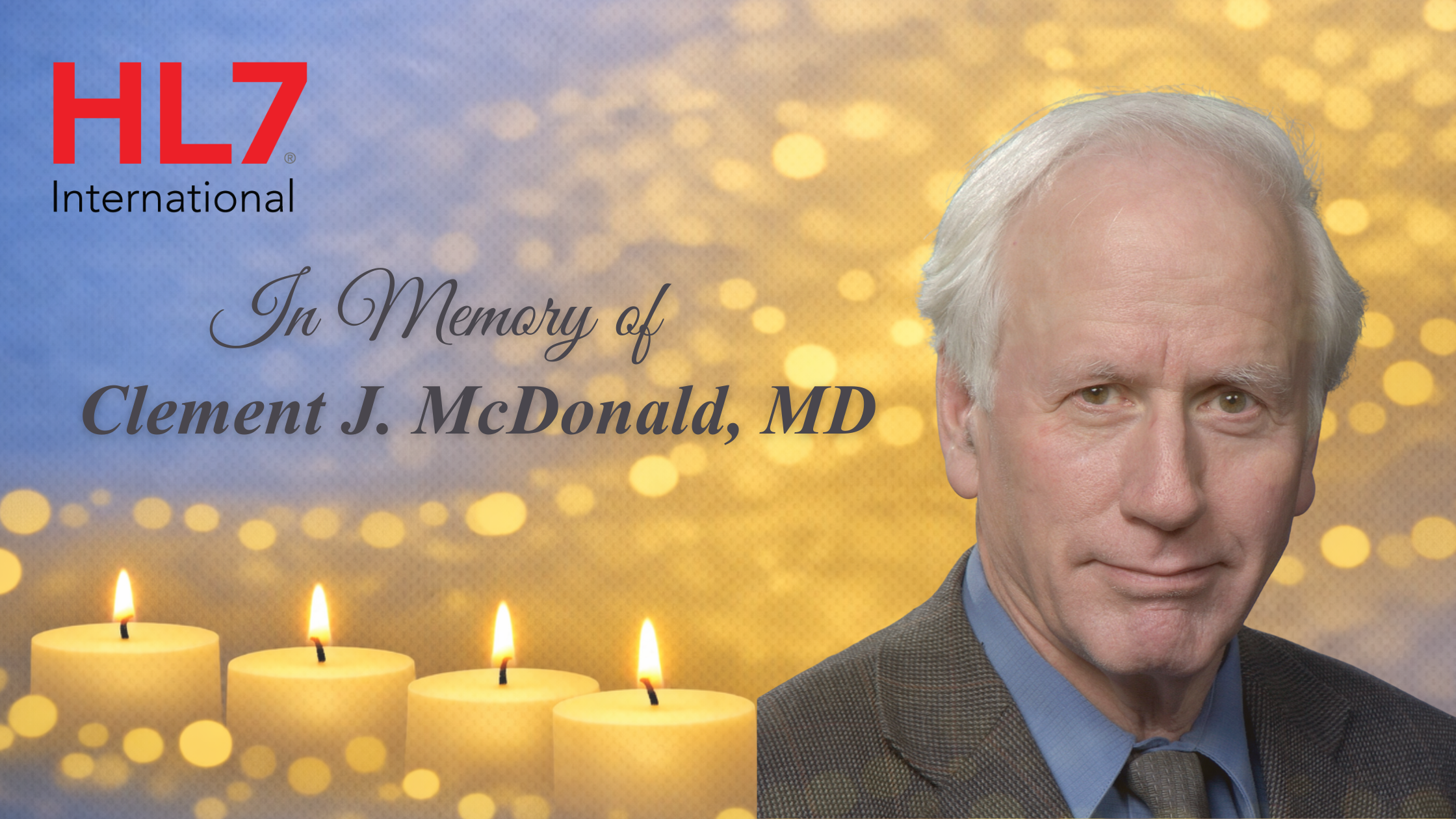
In Memoriam: Clement J. McDonald, MD — A Founder, a Force, and a Friend

[fa icon="calendar'] May 27, 2026 11:15:42 AM / by Daniel Vreeman, DPT posted in FHIR, HL7, HL7 community, interoperability, health IT, LOINC

[fa icon="comment"] 0 Comments


Today we honor the life and legacy of Clement J. McDonald, MD, who passed away on May 21, 2026.

Known worldwide as the one and only "Clem", he was a luminary in the field of biomedical informatics. Clem was a titan, world renowned for his innovations in electronic medical records, clinical decision support, multi-institution health data exchange, and especially in the global standards that enable computers to share and understand health data.

As a co-founder and life-long member of HL7 International, Clem's vision for interoperability enabled by consensus standards is encoded in our DNA.

A Pioneering Career

Clem grew up on Chicago's West Side, graduated from Notre Dame in three years, and attended the University of Illinois College of Medicine. He completed his internal medicine residency at Cook County Hospital and the University of Wisconsin, after which he joined Indiana University and the Regenstrief Institute in 1972. There he built one of the world's first electronic medical record systems and published the first randomized controlled trials demonstrating that computerized clinical decision support could improve care.

He rose through the academic ranks at the Indiana University School of Medicine to become Distinguished Professor of Medicine and the Sam Regenstrief Professor of Medical Informatics, and served as Director of the Regenstrief Institute from 1990 to 2006. He also developed the Indiana Network for Patient Care, a groundbreaking statewide health information exchange. Throughout this time, he also practiced primary care internal medicine in a safety-net clinic for more than 25 years (that ran on the EMR he created).

In 2004, Clem joined the U.S. National Library of Medicine where he first served as Director of the Lister Hill National Center for Biomedical Communications and Scientific Director of its intramural research program, and later serving as Chief Health Data Standards Officer — a position he held until his passing.

Read More [fa icon="long-arrow-right"]

Bridging Policy and Practice: Mastering CMS-0062-P through Real-World Da Vinci Implementations

[fa icon="calendar'] May 20, 2026 12:50:14 PM / by Leslie Amorós posted in FHIR, HL7, HL7 community, health IT policy, CMS, Da Vinci, FHIR Accelerator, PDex, FHIR Community, CMS-0062-P, Member Attribution List, PDex Plan Net

[fa icon="comment"] 0 Comments

May Community Roundtable on May 27 Offers More Insight into Proposed Rule and Payer Data Exchange

As the industry prepares for the next wave of healthcare interoperability, the HL7 Da Vinci Project is dedicated to providing the community with the insights and tools necessary for success. With newly proposed regulatory frameworks, the stakes for technical and operational alignment have never been higher. Join us for the May Community Roundtable on Wednesday, May 27, 2026, from 4 – 5:30 p.m. ET to prepare for what’s next.

What You’ll Learn

While our April session established the foundational context for the new federal rule (CMS-0062-P), the May session builds on the momentum by moving from initial impressions to active implementation strategies. We will provide a focused update of the community’s considerations regarding the 2026 Interoperability Standards and Prior Authorization for Drugs proposed rule, specifically focusing on the Payer Data Exchange (PDex), PDex Plan Net, and Member Attribution (ATR) List Implementation Guides (IGs) called out in the rule.

Real-World Perspectives & Demonstrations

Following the policy discussion, you will hear directly from implementers successfully deploying these standards in real-world payer environments:

  • Onyx: Discover how their implementations focus on moving data out of silos into standardized formats, providing endpoints for payers to make data available via HL7 FHIR IGs.
  • Availity: Watch a live demo of core PDex workflows, including member matching and data retrieval, and learn how a centralized network can reduce onboarding friction while preserving payer autonomy and PDex semantics.

Our presenters will share critical insights on scalability and how these implementations support broader policy goals around data access, care coordination, and patient empowerment.

Read More [fa icon="long-arrow-right"]

April Community Roundtable: Navigating the New CMS Proposed Rule for Drug Prior Authorization (CMS-0062-P)

[fa icon="calendar'] Apr 23, 2026 9:42:41 AM / by Leslie Amorós posted in FHIR, HL7, HL7 community, health IT policy, CMS, Da Vinci, prior authorization, ONC, FHIR Accelerator, FHIR Community, CMS-0057-F, CMS-0062-P

[fa icon="comment"] 0 Comments

Upcoming Da Vinci Community Roundtable on April 29 at 4:00 pm ET

The momentum for healthcare interoperability continues to accelerate. Following the CMS-0057-F final rule, the Centers for Medicare & Medicaid Services (CMS) and the Office of the National Coordinator for Health Information Technology (ONC) have introduced its next major regulatory step: the 2026 Interoperability Standards and Prior Authorization for Drugs Proposed Rule (CMS-0062-P).

Join the HL7 Da Vinci Project for the April Community Roundtable happening on Wednesday, April 29, 2026 at 4 p.m. ET as we break down this new proposal and discuss its implications for HL7 Fast Healthcare Interoperability Resources® (FHIR®) implementation and the industry at large. The new proposed rule relies heavily on the work of the HL7 Da Vinci Project community and could bring significant changes for industry, including adding Da Vinci implementation guides to Health Insurance Portability and Accountability Act of 1996 (HIPAA) requirements.

Featured Speakers

  • Denise St. Clair: HL7 Da Vinci Project PMO; Vice President, Health Policy & Interoperability, Global Alliant, Inc.
  • Alix Goss: Program Manager, HL7 Da Vinci Project; Senior Consultant, Point-of-Care Partners
  • Moderator: Casey Thompson: HL7 Da Vinci Project Program Coordinator; Consultant, Point-of-Care Partners
Read More [fa icon="long-arrow-right"]

How the 2026 HL7 AI Challenge Is Helping Shape the Future of Responsible AI in Healthcare

[fa icon="calendar'] Apr 22, 2026 9:17:24 AM / by Health Level Seven posted in FHIR, HL7, HL7 community, interoperability, health IT, AI, AI Challenge, AI in Healthcare

[fa icon="comment"] 0 Comments


If you’ve spent any time in healthcare over the past year, you’ve probably felt it: the energy, the urgency, the curiosity around AI. Everywhere you look, teams are experimenting with new models, exploring new use cases and imagining what care could look like if we finally had the right data in the right place at the right time.

But there’s also a shared realization emerging across the industry that AI can’t transform healthcare unless the data behind it is trustworthy, connected and interoperable.

That’s why HL7 International launched the 2026 HL7 AI Challenge, now officially open for submissions through June 30, 2026.

Why an HL7 AI Challenge?

Last year’s inaugural Challenge showed us something powerful: when innovators build on HL7 standards, they can move faster, scale more easily and create solutions that actually work in the messy, real‑world environments where healthcare happens.

Healthcare organizations around the world are experimenting with AI, but many face the same barriers: fragmented data, inconsistent formats, and limited ability to integrate AI outputs into clinical systems. HL7’s standards are designed to address these challenges, making them a natural foundation for safe and effective AI adoption.

The HL7 AI Challenge aims to:

    • Encourage innovation grounded in open, widely adopted standards
    • Demonstrate how structured, interoperable data improves AI performance
    • Highlight real‑world solutions that can scale across organizations and borders
Read More [fa icon="long-arrow-right"]

HL7 Launches Caliper: A New FHIR Accelerator Advancing Real‑Time Medical Device Interoperability

[fa icon="calendar'] Mar 24, 2026 4:18:47 PM / by Health Level Seven posted in FHIR, HL7, HL7 community, interoperability, health IT, IHE, Gemini, FHIR Accelerator, AI, AI in Healthcare, Caliper, Medicatl devices, Device Interoperability

[fa icon="comment"] 0 Comments


New implementation community builds on global collaboration to improve
real-time device data exchange for AI-enabled care

Imagine a patient in an intensive care unit, monitored by a dozen devices generating streams of critical data every second.  From operating rooms and ICUs to ambulatory clinics and patient homes, clinicians and care teams rely on a growing ecosystem of medical and personal health devices. Now imagine that data is siloed, unable to flow into the EHR and unreachable by the analytics platform that might detect a dangerous trend before a clinician does.

This fragmentation is a well-known challenge in healthcare IT. On March 5, 2026, HL7 International took a major step toward solving it with the launch of the Caliper FHIR® Accelerator, a new implementation community dedicated to improving how data from medical and personal health devices is exchanged, integrated and used across healthcare systems. 

Why Caliper, and Why Now?

Caliper builds on HL7’s 2025 work with founding members to define a collaborative community focused on device interoperability. The need is clear: healthcare organizations are generating more high‑frequency device data than ever, but too often this information cannot flow cleanly into EHRs, analytics platforms or AI‑driven applications.

By leveraging HL7 FHIR alongside established device communication frameworks, Caliper aims to create a scalable, standards‑based foundation for real‑time device data integration. The goal is simple but transformative: ensure that data from critical care equipment and patient‑facing technologies can be shared consistently, reliably and safely.

“Healthcare systems are entering a new phase where access to high-quality, real-time data is essential to safely deploying advanced analytics and AI,” said Rachel Dunscombe, CEO of HL7 International. “The Caliper Accelerator represents an important step forward in ensuring that device-generated data, whether from critical care equipment or patient-facing technologies, can be shared and used consistently across care environments worldwide. This kind of foundational interoperability is critical to improving both clinical outcomes and operational resilience.”

Read More [fa icon="long-arrow-right"]

Navigating Patient Cost Transparency Using HL7 FHIR: Insights from Industry Leaders

[fa icon="calendar'] Feb 20, 2026 9:21:14 AM / by Leslie Amorós posted in FHIR, HL7, HL7 community, Da Vinci, FHIR Accelerator, FHIR Community, PCT, FHIR adoption

[fa icon="comment"] 0 Comments

Upcoming Da Vinci Community Roundtable on February 25 at 4:00 pm ET

As the federal government signals stronger enforcement and clearer expectations for healthcare pricing transparency, the ability for patients to make informed decisions has become a cornerstone of modern care efforts. The HL7® Da Vinci Project Community Roundtable, taking place on February 25, 2026, from 4 – 5:30 p.m. ET, will bring together the pioneers who are turning these regulatory expectations into reality.

The January roundtable set the stage for 2026 by focusing on overall use case progress and adoption readiness. This February session, “Navigating Patient Cost Transparency Using HL7 FHIR: Insights from Industry Leaders,” zooms in on Patient Cost Transparency (PCT), moving from the "why" of transparency to the "how" of implementation. Attendees will hear directly from early adopters about how they are navigating the complexities of Good Faith Estimates (GFE) and building the infrastructure for a more patient-centric ecosystem.

The upcoming 90-minute session will focus on:

  • The Evolving Transparency Landscape: An overview of how recent federal actions and the No Surprises Act are driving an industry effort to increase transparency and empower patients.
  • Standardizing Good Faith Estimates: Insights into the HL7 FHIR-based approach to PCT and how it automates the exchange of cost data between providers and payers.
  • Real-World Pilot Progress: First-hand accounts from Aetna/CVS Health and Kyruus Health on how they are leveraging FHIR along with their existing infrastructure and previous work to streamline implementation of PCT, as well as lessons learned.
  • The Role of Innovative Apps: How standardized data enables accurate, real-time access to medical costs via consumer-facing applications prior to the delivery of care.
  • Collaboration Strategies: What organizations should keep in mind when working in an ecosystem-based solution, where it’s not just one group involved but a whole mix of partners that need to collaborate for success.
Read More [fa icon="long-arrow-right"]

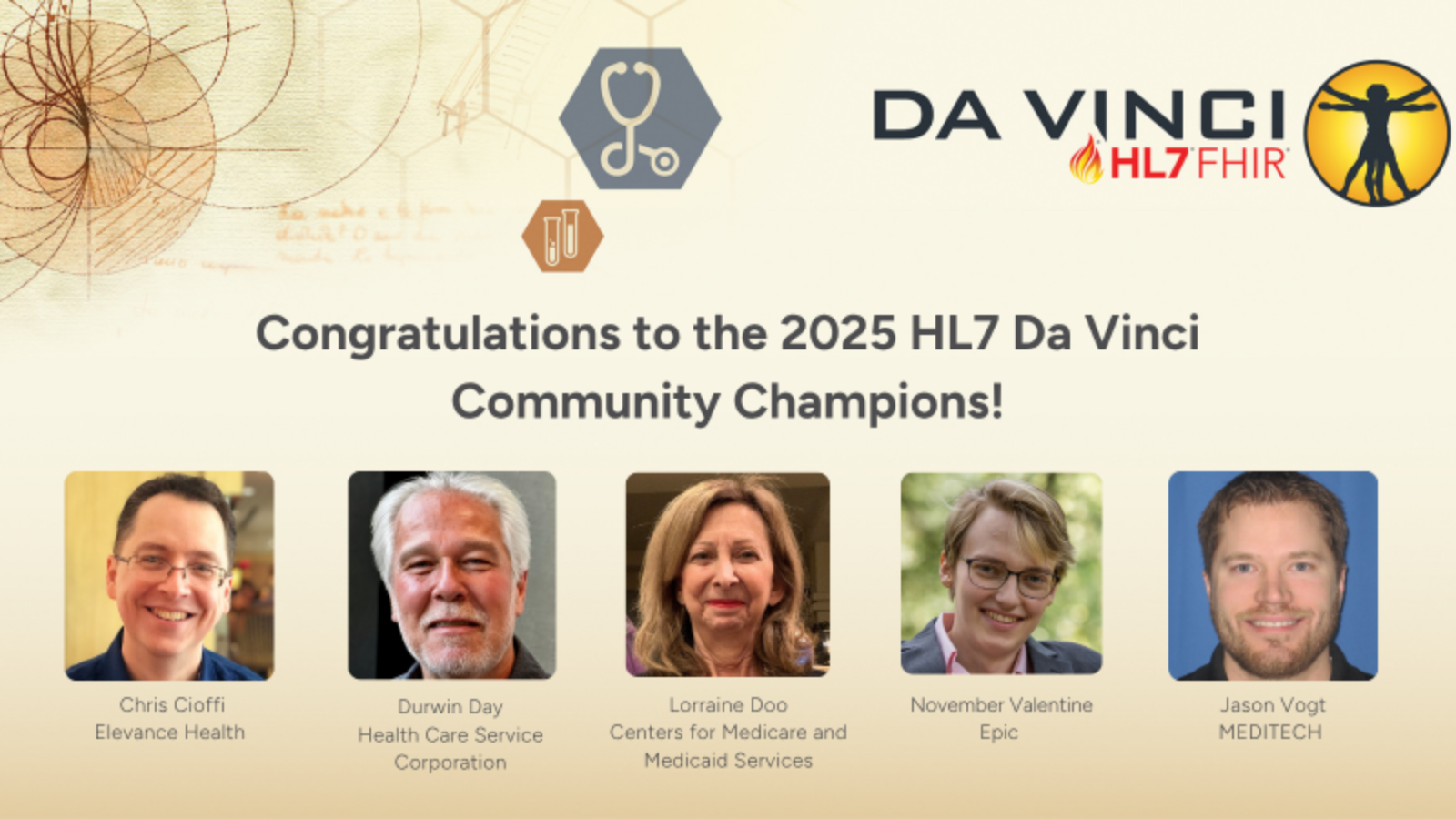
Celebrating Collaboration: HL7® Da Vinci Project Extends Nominations for 2025 Community Champions

[fa icon="calendar'] Jan 30, 2026 3:02:32 PM / by Leslie Amorós posted in FHIR, HL7, HL7 community, Da Vinci, FHIR Accelerator, Da Vinci Champions, FHIR Community, FHIR adoption

[fa icon="comment"] 0 Comments

The HL7® Da Vinci Project is extending the deadline to nominate outstanding contributors for its 2025 Community Champions recognition program. Community members now have until Friday, February 6, 2026, to submit nominations, giving an extra week to spotlight colleagues and collaborators who are making a real impact on healthcare interoperability.

The Community Champions program honors individuals from across the Da Vinci Project's diverse, multi-stakeholder ecosystem, including health plans, provider organizations, accountable care organizations (ACOs), and health IT vendors. As an HL7® FHIR® Accelerator, the Da Vinci Project brings together public and private sector leaders to advance standards that support automated workflows, real-time data exchange, reduced administrative burden and improved care coordination.

Since launching in 2020, the Community Champions program has recognized individuals who embody a spirit of “industry above self.” Champions are known for their collaboration, leadership, and commitment to advancing real-world adoption of HL7 FHIR standards in support of value-based care and a more connected healthcare system.

Read More [fa icon="long-arrow-right"]

HL7 International Appoints Patrick McGinn as Chief Operating Officer

[fa icon="calendar'] Jan 27, 2026 3:37:19 PM / by Health Level Seven posted in HL7, HL7 community, health IT, HL7 Leadership, COO

[fa icon="comment"] 0 Comments


HL7 International has announced the appointment of Patrick (Pat) McGinn, MBA, CAE, as its new Chief Operating Officer (COO), strengthening the organization’s leadership team during a pivotal period of transition.

Pat brings more than 20 years of executive leadership and operational experience across professional associations. He joins HL7 from the American Society of Civil Engineers (ASCE), where he most recently served as Director of the Utility Engineering & Surveying Institute, leading strategic planning, program development, education and standards initiatives, and member engagement.

In his role as COO, Pat will oversee HL7’s operational functions, including technology, membership services, and internal operations, while supporting the organization’s global mission to enable safe, scalable health data exchange.

Read More [fa icon="long-arrow-right"]

Driving Change in 2026: Use Case Progress and Preparing for HL7 FHIR Adoption

[fa icon="calendar'] Jan 22, 2026 2:02:16 PM / by Leslie Amorós posted in HL7, HL7 community, health IT policy, health IT, Payers, CMS, Da Vinci, prior authorization, policy, CMS-0057

[fa icon="comment"] 0 Comments


Join Us for the January Da Vinci Project Community Roundtable on January 28, 2026, from 4 - 5:30 pm ET

As we enter 2026, the healthcare industry continues to move from planning to active implementation of standardized data exchange. Because the first phase of the CMS-0057-F Interoperability and Prior Authorization Final Rule took effect this month, the stakes for technical and operational alignment have never been higher. The HL7 Da Vinci Project Community Roundtable, taking place on January 28, 2026, from 4 – 5:30 pm. ET,  will provide insights and resources to navigate this pivotal year.

What You'll Learn

Our previous sessions focused on how using Da Vinci burden reduction and payer data exchange IGs are transforming healthcare and how best to meet prior authorization regulatory requirements. This January session builds on that foundation by outlining key use cases, IGs, and the progress made in standardized data exchange.

Gain valuable knowledge on operational enhancements and resources to optimize your planning for smoother HL7 FHIR implementations, including implementation guides referenced in federal regulations. Additionally, hear about Da Vinci's 2026 priorities and the HL7 Da Vinci Community Champions program. 

Read More [fa icon="long-arrow-right"]

HL7 International Appoints Professor Rachel Dunscombe as New CEO

[fa icon="calendar'] Jan 13, 2026 3:38:48 PM / by Health Level Seven posted in HL7, HL7 community, health IT, HL7 Leadership, openEHR

[fa icon="comment"] 0 Comments

HL7 has announced the appointment of Professor Rachel Dunscombe as its new Chief Executive Officer effective January 19, marking the start of the organization’s next phase of growth in global health data interoperability. She succeeds Charles Jaffe, MD, PhD, who concludes nearly two decades of leadership at HL7.

Rachel brings extensive global experience in digital health, interoperability and standards-based transformation. Prior to joining HL7, she served as CEO of openEHR International, where she helped accelerate worldwide adoption of open health data standards and strengthened collaboration among governments, standards bodies and healthcare organizations.

Her career includes senior roles in healthcare delivery, national digital strategy, executive education and leadership in international standards communities. She has been recognized for her ability to unite diverse stakeholders and advance practical implementation of health data standards at scale.

Read More [fa icon="long-arrow-right"]

Lists by Topic

see all

Posts by Topic

see all