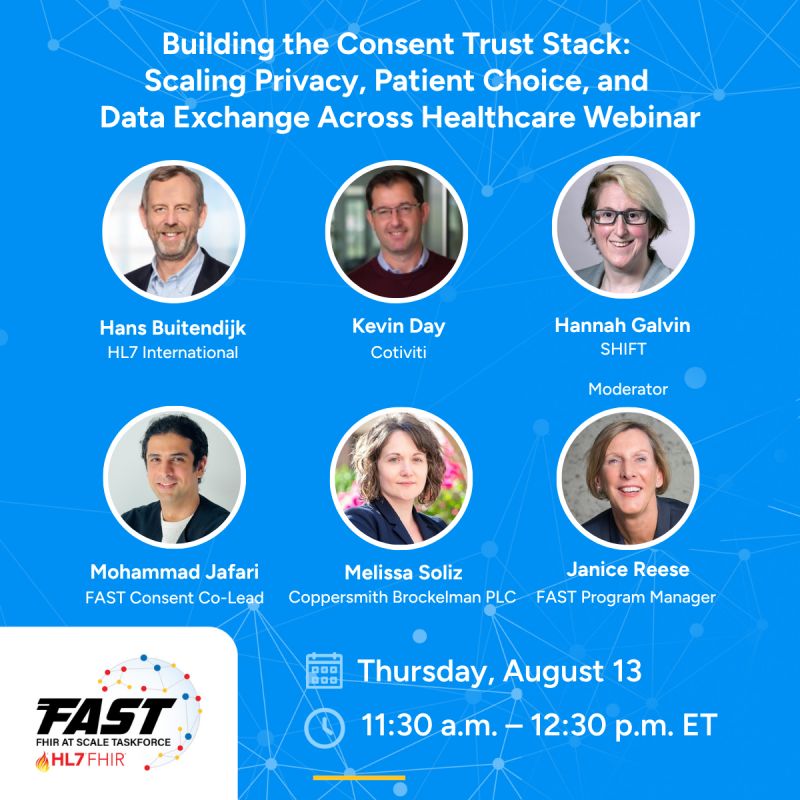
Co-authored by Kevin Day, Consent Implementation Guide Co-Lead, FAST FHIR Accelerator
MEET MARIA
Maria is 62 and just home from the hospital after a procedure that requires careful follow-up. Her care team has discharged her with medications, recovery instructions, and a treatment plan her health plan put in place to manage cost. Her husband took time off work to help her recover at home—administering medications, watching for warning signs, coordinating with the visiting home health nurse, and calling the health plan when questions came up about coverage and the treatment plan.
There is one complication. Decades ago, before Maria met her husband, she received sensitive care she has chosen not to share with him; care that is in her medical record and always will be. So when the hospital asked Maria at discharge whether she wanted to grant her husband access to her clinical information, she faced a binary choice: all or nothing. There was no option to share the medications and care plan he needed while keeping the rest of her history private. The system doesn't support that nuance, so Maria selected nothing.
Her husband helps her recover with whatever Maria can tell him in the moment—what each pill is for, when the next appointment is, and what the home health nurse said. When he calls the health plan to ask why one therapy was authorized but another was not, he is told he is not on the consent and the conversation cannot continue. The clinical care suffers. So does the emotional care. Two weeks in, he is frustrated, and Maria is exhausted from carrying both her recovery and the running translation of her own chart.
Maria’s story is not unusual. Across the country, patients, providers, payers, and the family members who do the actual work of recovery face a quiet crisis hiding inside healthcare’s interoperability progress: the problem of consent.
The Hidden Roadblock: When Consent Doesn’t Scale
Healthcare interoperability has made remarkable strides. Data can now move faster, further, and more securely than ever before. Yet one foundational challenge continues to limit what that progress can achieve: how patient consent is captured, communicated, and enforced across organizations.
Today, consent is fragmented. A patient authorizes data sharing at one organization, but that authorization rarely travels with the data. In the context of data privacy and consent, a “policy” is the set of provisions that govern a specific grantor–grantee relationship—what may be disclosed, to whom, for what purpose, for how long, and under what conditions. Those provisions also drive enforcement decisions when consents conflict, such as when an additive permission from one source overlaps with a restriction from another. The operational burden of capturing them varies widely depending on the setting. In clinical environments, consent is typically tied to an encounter or event, such as a 30-minute office visit or a three-week inpatient stay, and expires when that event ends. Health plans, by contrast, capture consent that remains valid until a specified expiration date or until the patient revokes it. The result is a tangled consent relationship tree, where each branch—provider, payer, app, caregiver, personal representative—holds a different fragment of the patient’s intent, with different lifespans, scopes, and enforcement rules. Because no two systems interpret these provisions the same way, organizations fall back on manual review to reconcile conflicts, slowing workflows to a crawl at the exact moments when trust matters most. Compliance burden rises. Patients are left in the dark about how their information is used. And interoperability stalls precisely where it should accelerate.
This is the problem the HL7® FHIR® at Scale Taskforce (FAST) set out to solve.