
The Standard

The Official Blog of Health Level Seven® International

visit HL7.org 

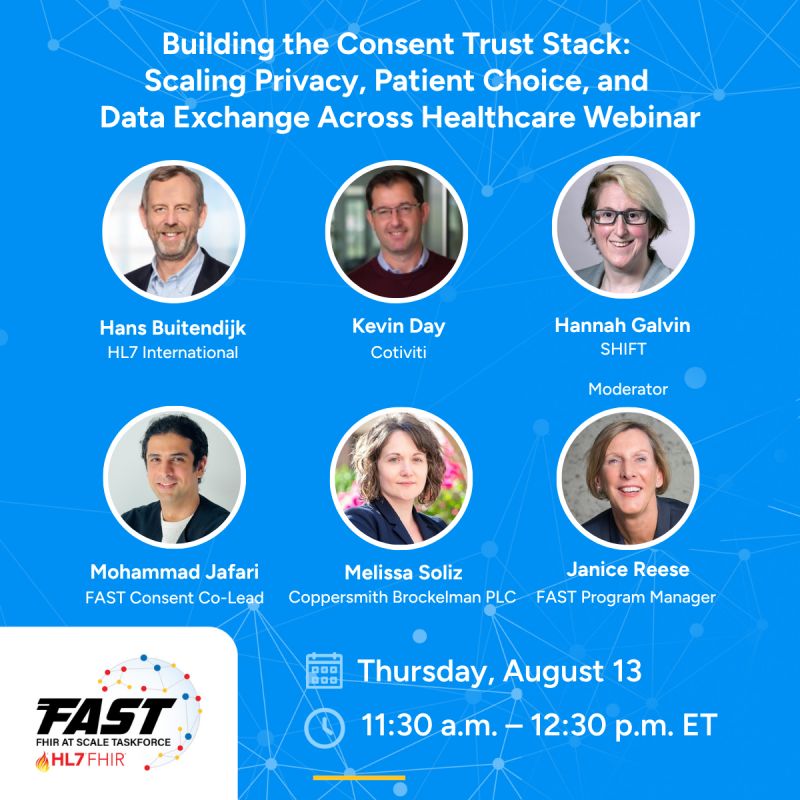
Building a Healthy Digital Future with HL7 FAST FHIR at Scale

[fa icon="calendar'] Feb 4, 2026 10:38:20 AM / by Janice Reese posted in FHIR, CMS, FHIR Accelerator, FAST, FHIR Implementation Guides, FHIR Community, FAST Security, FAST Identity, FHIR Consent, FAST Directory

[fa icon="comment"] 0 Comments

Those of us working across health policy, technology, and standards are reimagining a system where individuals experience better outcomes, lower costs, and greater trust in how their health information is used and shared.

At HL7® International, a global standards development organization with members and affiliates in more than 50 countries, we are meeting our challenge head-on through collaboration and innovation. The HL7® FHIR® at Scale Taskforce (FAST) Accelerator takes that mission further by tackling the hard problems of scalability: Identity, Security, Consent, and National Directory services. These components are the backbone that supports the CMS Health Tech Ecosystem and Aligned Networks Pledge.

Paired with the Da Vinci Project, which applies FHIR to payer–provider workflows like prior authorization, clinical data exchange, payer data exchange, and patient cost transparency. HL7 is aligning infrastructure with real-world use cases. Da Vinci has recognized the value of FAST standards by selecting FAST Security as part of their security recommendations in their core health record exchange (HRex) specifications, showing a convergency across the ecosystem.


Where Sequoia’s RCE Role Elevates the Work: TEFCA as the National Trust Layer

FAST isn’t building infrastructure in a vacuum. Its work aligns with the Trusted Exchange Framework and Common Agreement (TEFCA), led by The Sequoia Project as the Recognized Coordinating Entity (RCE) for ASTP/ONC. TEFCA is a national framework for the secure and trusted exchange of clinical data across networks.

Read More [fa icon="long-arrow-right"]

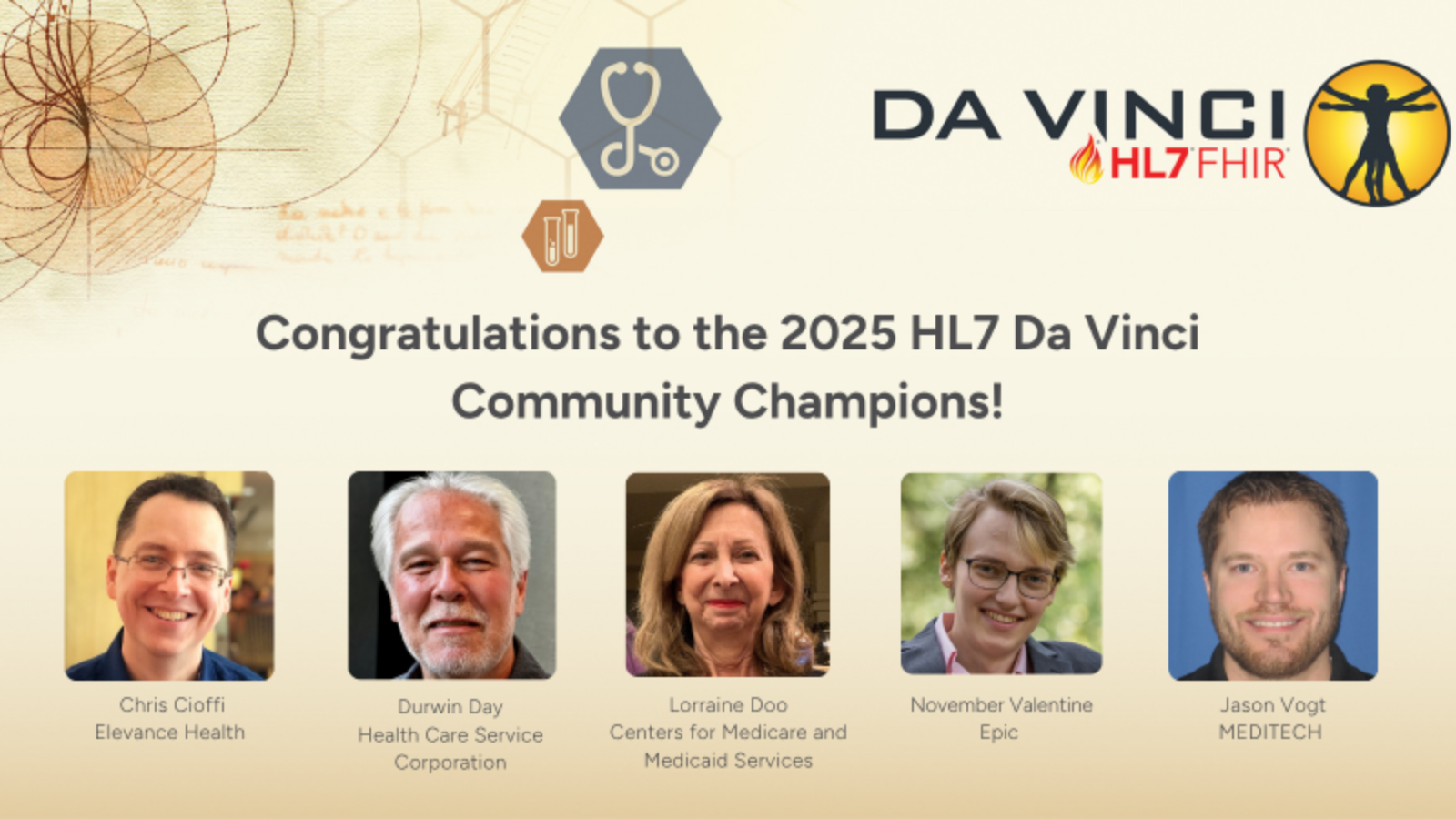
Celebrating Collaboration: HL7® Da Vinci Project Extends Nominations for 2025 Community Champions

[fa icon="calendar'] Jan 30, 2026 3:02:32 PM / by Leslie Amorós posted in FHIR, HL7, HL7 community, Da Vinci, FHIR Accelerator, Da Vinci Champions, FHIR Community, FHIR adoption

[fa icon="comment"] 0 Comments

The HL7® Da Vinci Project is extending the deadline to nominate outstanding contributors for its 2025 Community Champions recognition program. Community members now have until Friday, February 6, 2026, to submit nominations, giving an extra week to spotlight colleagues and collaborators who are making a real impact on healthcare interoperability.

The Community Champions program honors individuals from across the Da Vinci Project's diverse, multi-stakeholder ecosystem, including health plans, provider organizations, accountable care organizations (ACOs), and health IT vendors. As an HL7® FHIR® Accelerator, the Da Vinci Project brings together public and private sector leaders to advance standards that support automated workflows, real-time data exchange, reduced administrative burden and improved care coordination.

Since launching in 2020, the Community Champions program has recognized individuals who embody a spirit of “industry above self.” Champions are known for their collaboration, leadership, and commitment to advancing real-world adoption of HL7 FHIR standards in support of value-based care and a more connected healthcare system.

Read More [fa icon="long-arrow-right"]

From Policy to Practice: FAST Advances Consent, Identity, Security and Directory for CMS-Aligned Networks

[fa icon="calendar'] Dec 18, 2025 11:02:33 AM / by FAST Project Management Team posted in FHIR, FAST, FHIR Connectathon, FHIR Implementation Guides, ONC FAST, FHIR Community, webinar, FAST Security, FAST Identity, FHIR Testing, FAST Directory

[fa icon="comment"] 0 Comments

The HL7® FHIR® at Scale Taskforce (FAST) continues to translate national interoperability policy into implementable, real-world infrastructure. This month marks several major milestones, including the opening of the FAST Consent Ballot, the official publication of FAST Identity STU 2 and FAST Security STU 2, and continued progress on FAST National Directory toward STU 2. This reinforces the growing momentum toward CMS-Aligned Networks powered by FAST. 

These advances demonstrate how standards, trust frameworks, directory infrastructure and testing at scale converge to support scalable, secure and interoperable data exchange across the healthcare ecosystem. 


FAST Consent Ballot: Advancing Scalable, Network-Ready Consent 

The FAST Consent Implementation Guide (Edition 1 – US Realm) has entered formal HL7 balloting, providing the industry with a practical, interoperable approach to consent management at scale. 

The guide is designed to support: 

  • Computable and portable consent representations across organizational and network boundaries 
  • Subscription-based workflows for consent updates and downstream disclosures 
  • Alignment with FAST Identity, FAST Security, and FAST Directory infrastructure 
  • Use cases spanning payer-to-payer exchange, provider workflows, HIEs, and consumer-mediated access 

Read More [fa icon="long-arrow-right"]

AI-Conformable Venous Atlas: A Novel Solution for Clinical-Structural Correlation and Medical Device Surveillance

[fa icon="calendar'] Nov 24, 2025 4:03:15 PM / by Robert Lario, PhD posted in FHIR, HL7, HL7 community, health IT, FHIR Community, AI, AI Challenge, DICOM

[fa icon="comment"] 0 Comments

 Overall Winner

The  Integrated Medical Management and Educational Gateway (IMMEG) Venous Management System (I-VMS) is an AI-enabled, standards-based platform that projects a vectorized atlas of the deep thoracic venous system onto routine chest radiographs. Using deep-learning landmark detection and HL7 FHIR®/DICOM interoperability, the system lets clinicians visualize the catheter trajectory and tip position in patient-specific anatomy, record planned versus actual placement, and build a reusable, longitudinal venous access record across organizations. The project was developed for Vanguard with support from Xzyos.ai. 

Clinical Problem and Context 

Central venous access is essential for chemotherapy, parenteral nutrition, dialysis and critical care, yet malposition and related complications—venous injury, thrombosis, infection, and device dysfunction—remain common and costly. Post-procedure assessment usually relies on plain chest X-rays, which do not directly visualize venous structures. As a result, clinicians infer anatomy indirectly; documentation is inconsistent; and comparing procedures over time is difficult. There is no consolidated, spatially normalized record of a patient’s venous history to guide future decisions.

Core Innovation

 I-VMS predicts anatomical landmarks (e.g., carina, first thoracic vertebra T1, lateral edge of the right rib) on a radiograph with a modified DenseNet121 model implemented in MONAI. These coordinates establish a patient-specific basis for an affine transformation that overlays a standardized, vector-based venous atlas onto the image. Clinicians can accept or adjust landmarks and annotate intended and actual entry and tip positions. Because annotations are stored in a normalized coordinate space, results are comparable across encounters and over time, enabling longitudinal analysis and population-level learning.

Read More [fa icon="long-arrow-right"]

Building the Standards Infrastructure for Healthcare AI: Lessons from the Interoperability Journey

[fa icon="calendar'] Nov 14, 2025 10:59:35 AM / by Daniel Vreeman, DPT posted in FHIR, HL7, HL7 community, interoperability, health IT, AI, AI Challenge, AI Office

[fa icon="comment"] 0 Comments


Reflections from the ADAPT Chief AI Officers on Innovation Panel Discussion, November 2025

After decades of working toward seamless health data interoperability, we find ourselves at another pivotal moment. The rapid adoption of Artificial Intelligence (AI) in healthcare presents us with a familiar challenge wearing a new face: how do we ensure these powerful new tools work together transparently, accountably, and in the service of better health for people everywhere?

At a recent ADAPT conference panel, I had the opportunity to reflect on what our interoperability journey can teach us as we venture into standardizing intelligence, not just data. Here are some key insights from that conversation.

The Journey Continues

First, a grounding perspective: this is a journey, not a destination. Despite all the progress we've made in healthcare interoperability, too often, people still move faster and further than their health information. The ability for any digital tool—including AI—to help people make better health decisions is always limited by the scope of data in its purview and its capability to make sense of it.

Even the most powerful AI we can imagine must overcome the same boundaries we've always faced: technical, organizational, business, and jurisdictional barriers that prevent us from seeing the complete picture of health information relevant for individuals or populations.

However, HL7's decade-plus journey with Fast Health Interoperability Resources (FHIR® ) has taught us something crucial: open standards are a potent fuel for innovation. The vibrant, open, collaborative community around FHIR wasn't just a nice byproduct—it was the key force that created a well-tuned specification and enabled it to flourish in the marketplace.

Open standards level the playing field, reduce barriers to participation, and free organizations from proprietary formats. They unlock new connectivity, preserve data sovereignty, and most fundamentally, enable new digital freedoms. As we approach AI standardization, maintaining this commitment to openness isn't guaranteed, but it's the future we're fighting for.

Read More [fa icon="long-arrow-right"]

They Said Healthcare Was Hard. They Just Didn’t Know Our Story.

[fa icon="calendar'] Oct 30, 2025 2:34:37 PM / by William Laolagi and Diane Nguyen posted in FHIR, HL7, HL7 community, SMART on FHIR, health IT, FHIR Community, AI, AI Challenge

[fa icon="comment"] 0 Comments

 Winner of the Transformative Impact in Healthcare Award

What do you do when the people who taught you everything start to forget? My father is fighting Parkinson's and early dementia. My mother manages diabetes and congestive heart failure. My three siblings and I are a team — a family armed with love but disarmed by the chaos of a dozen medications, forgotten instructions, and missed questions. We were losing the battle against complexity, and that feeling is where this story truly begins.

 The seed for what would become Let's Talk Doc was planted six or seven years ago. My friend and partner, Diane Nguyen, and I saw the cracks in the system through our own eyes. I saw it in my parents' home, and she saw it as an immigrant facing the silent fear that a single misunderstood word on a form could alter her family's care. We tried to build something back then, a small solution born from our shared frustrations. But the technology wasn't ready. The idea was a spark, but we couldn't yet build the engine.  

Years passed. Then, earlier this year, Diane reached out. The world had changed. Technology had finally caught up to our ambition. "It's time," she said. "Let's try again."

 This is not a business venture for us. It’s a mission.

Read More [fa icon="long-arrow-right"]

HL7 International Launches BPM Community of Practice

[fa icon="calendar'] Jul 17, 2025 8:20:46 AM / by Health Level Seven posted in FHIR, HL7, HL7 community, interoperability, health IT, BPM, BPM Community of Practice

[fa icon="comment"] 0 Comments

New Group Advances Workflow and Process Interoperability Using HL7® FHIR®

HL7 is pleased to announce the official launch of its HL7 Business Process Modeling (BPM) Community of Practice. Now open for membership, the community is dedicated to advancing interoperability, process consistency, and process automation through the use of formal modeling techniques promoting better modeling, sharing, and execution of clinical and administrative workflows across the healthcare ecosystem.

BPM Community of Practice builds upon three open standards-based languages – referenced together as “BPM+”, and include:  

  • BPMN (Business Process Model and Notation): For prescriptive workflows
  • CMMN (Case Management Model and Notation): For reactive activities
  • DMN (Decision Model and Notation): For complex decision-making rules

The use of these standards, in concert, allows inherent ambiguities in natural-language guidelines to be clarified, providing precise, automatable guidance to improve care quality and consistency. Organizations use BPM+ to model and streamline processes, ensuring accurate and scalable healthcare delivery, process consistency, comparability, and repeatability.

“HL7’s focus is on bringing together communities to advance all aspects of interoperability, and that includes workflow and care processes,” said Ken Rubin, Community Coordinator of the HL7 BPM Community of Practice. “This launch marks an important step in providing the healthcare industry with tools, models, and frameworks to manage care processes more effectively, consistently, and collaboratively.”


Read More [fa icon="long-arrow-right"]

Accelerating FHIR Adoption: June 2025 Da Vinci Roundtable Shares Clinician Insights

[fa icon="calendar'] Jun 19, 2025 1:30:31 PM / by Leslie Amorós posted in FHIR, HL7, Da Vinci, value based care, FHIR Accelerator, FHIR adoption

[fa icon="comment"] 0 Comments

Community Roundtable Featuring Clinical Advisory Council Insights on FHIR Adoption on June 25 at 4 pm

Read More [fa icon="long-arrow-right"]

Moving the Needle and the Timeline on Clinical Research

[fa icon="calendar'] Jun 10, 2025 3:22:01 PM / by Vulcan Project Management Office posted in FHIR, interoperability, clinical research, FHIR Accelerator, Vulcan

[fa icon="comment"] 0 Comments

 Join the Vulcan Interoperability Bridge Webinar | Thursday, June 12 at 1:00 PM ET 

The story of clinical research has always been one of astounding breakthroughs… and barriers. It’s the story of research, regulators and technologists working together, and more recently, the story of equitable access and activated patients empowered to share their experiences. Clinical research is evolving — and it’s happening through the collective efforts of a passionate, deeply engaged community.

On June 12, we invite you to be part of that evolution.

The Vulcan Interoperability Bridge Webinar, hosted by the Vulcan FHIR® Accelerator in collaboration with the FDA, will bring together clinical research sponsors, EHR providers, life science leaders, technology innovators, academic medical centers and more — all working toward a future where HL7 Fast Healthcare Interoperability Resources (FHIR)-based interoperability enables smarter, faster and more connected clinical research.

Behind this movement is a simple truth: we can’t innovate in isolation. This is precisely where Vulcan makes a difference by breaking down barriers. Every delay in data sharing, every barrier caused by disconnected systems, slows the path from discovery to patient benefit.

Read More [fa icon="long-arrow-right"]

Unlocking the Power of PDex: How Payers Are Driving Transparency, Value-Based Care, and Data Exchange

[fa icon="calendar'] May 20, 2025 1:37:55 PM / by Leslie Amorós posted in FHIR, Da Vinci, value based care, FHIR Accelerator, PDex

[fa icon="comment"] 0 Comments

Community Roundtable Featuring Payer Data Exchange Implementation Guide on May 28 at 4 pm

If you're looking for a real-world take on how the healthcare industry is putting the HL7 Da Vinci Project’s Payer Data Exchange (PDex) Implementation Guide into action, you won’t want to miss this event! The 90-minute virtual community roundtable will feature how organizations are using FHIR-based APIs to improve transparency and value-based care.

How Organizations Are Using PDex in Production Today

After a brief update on the PDex Implementation Guide from Da Vinci’s technical director, attendees will hear about implementation considerations and first-hand implementer accounts from those actively applying PDex to solve real-world data exchange challenges:

  • Blue Cross Blue Shield Association + InterSystems will discuss the immense potential of payer-to-payer APIs to increase patient transparency and improve value-based care in light of the high levels of churn of the impacted population, resulting in care gaps and a need to provide patients with longitudinal records of care. Presenters will highlight the relevant Implementation Guides and the workflow issues inherent in the process that are being worked on. 

  • Availity, Healow Insights, and Humana will explore their experience with payer-to-payer data sharing using PDex—including workflow impacts, scaling considerations, and member-centered outcomes. Availity and Humana will share its observations and lessons learned along their payer-to-payer implementation journey through internal development, coordinating with their cohort of payers, and participating in Connectathons. Then Healow will highlight its experiences from two years in PDex production. 
Read More [fa icon="long-arrow-right"]

Lists by Topic

see all

Posts by Topic

see all